One Script Saved Me Two Hours and Made Me Addicted to Automation - Pt 3
Series: Part 3 of Fluffy Duck
This series reverse-engineers how failure rewired me, shaping my engineering mindset, automation philosophy, and systems design approach.
By 2007, I was clearing around $2,000 a week. In today’s money, that’s roughly $3,000 a week, about $75 an hour if you compare it to a standard 40-hour job. I wasn’t working anywhere near 40 hours, but if I had been, that would have been equivalent to a full-time job paying around $75/hour in today’s terms.
But there was a problem. And it was about to teach me the most important lesson of my entire career.
Lingerie imports and market lessons
The lingerie business started because I wanted something for myself. After having kids, I was overweight and too embarrassed to shop in stores. Looking online on the same platform where I'd sold reward charts, I found a supplier selling lingerie. The product looked nothing like the photos, but they were selling lots of them every week.
I tracked them for weeks, then spent more weeks hunting down their supplier. Once I found the source, I knew I could do better.
Basically I stalked a business until I found their supplier. Totally normal entrepreneur behavior.
I looked at how competitors were listing their products. They were doing the bare minimum, using generic supplier photos that looked nothing like the actual products. I took actual photos of the real products and used Photoshop to composite them onto models. It sounds funny, but it made all the difference. My listings showed exactly what customers were actually buying, not some airbrushed fantasy. Better descriptions, better photos, better categorisation. I built listings that actually sold, not just existed.
Then I found my niche within the niche. Customers started messaging me directly asking for larger sizes, sizes like 5XL that nobody else offered. I didn't have them in stock, but instead of saying no, I asked my supplier if they could manufacture them. They said yes.
Suddenly I became the only seller offering beautiful plus-size lingerie in those sizes. These customers were incredibly grateful. They became my main customer base, not just a side segment. I'd accidentally built a business around dignity and inclusion while everyone else ignored that market entirely.
I dominated that market for over 2 years. At my peak, I was working max 8 hours a week, I'd emptied out a spare room and used it strictly for business, benefiting from tax deductions. Shelves after shelves holding product packages. My spare room looked like a lingerie warehouse. Try explaining that one to visiting relatives. My competitors couldn't sustain the pace. Neither could I, really. I was just too stubborn to admit it yet.
In hindsight, those 8 hours a week meant I was effectively earning the equivalent of around $375 an hour in today’s money. I wasn’t thinking in hourly rates, I was just trying to stay ahead of demand, but I’d accidentally built leverage.
The breaking point
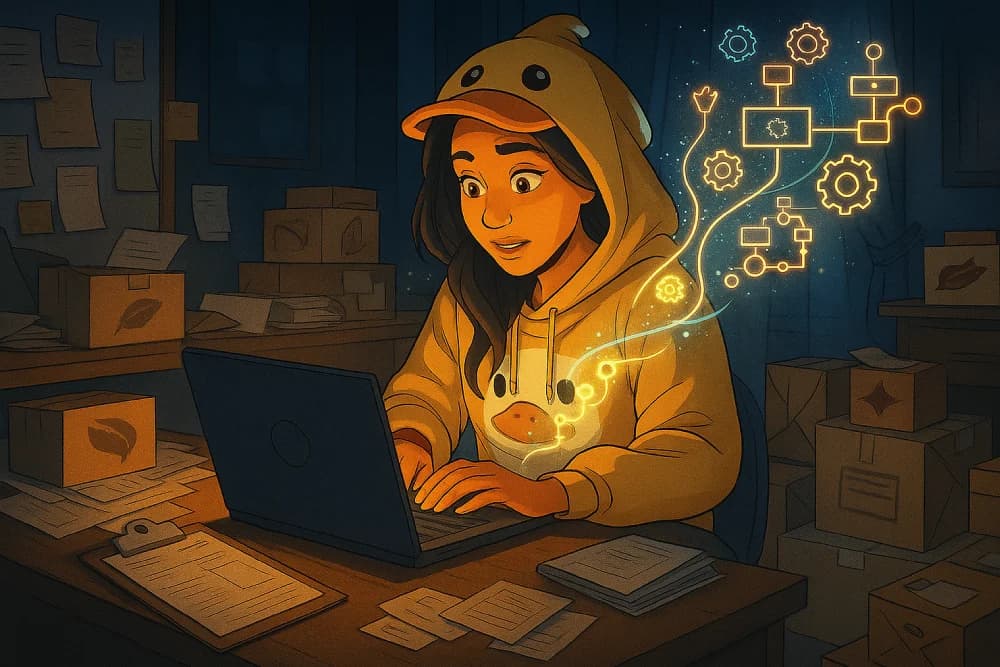
During the lingerie phase, manually listing 200 items every single day became my life. The modern entrepreneur's version of pushing a boulder uphill. Listings expired quickly, so relisting took nearly two hours daily. For weeks. Meanwhile, I was raising my kids, so I squeezed it in late at night after bedtimes or frantically during the day. Trapped in the routine, grinding away, watching my life disappear into repetition. I knew there had to be a better way.
It didn't take me long before I decided to write a small script to do it automatically. Two hours became two minutes.
That moment felt like magic. Like I'd discovered a superpower I didn't know existed.
That one script freed up my entire afternoon, time I never thought I'd get back. Every hour I won back through code was an hour I could give to my sons instead of losing to repetition. Suddenly I had my life back.
The obsession begins
From there, I became obsessed with automation. I built scripts to generate address sheets, post customer feedback, track income. I created a financial tool to calculate profit margins on the fly. Every tedious task became code. Every repetitive hour became minutes.
I'd built something that worked for me while I slept, while I did something else, while I lived. For the first time, I wasn't just running a business. I was designing a system. I'd found the leverage I didn't know I was looking for. And I wanted more of it.
I didn't live by that lesson perfectly at first. Later in my career I had to relearn it the hard way. But once I understood what real leverage felt like, it reshaped how I approached every system I built from then on.
When the market shifted
Then everything changed. The exchange rate decided to ruin my margins. My supplier priced everything in US dollars, and as the currency fluctuated, my profit margins shrank. What had been a 30% margin became 5%. Then negative.
But it got worse. My supplier's quality dropped significantly. I was selling so fast that I'd run out of good inventory to list. Returns increased. Then import taxes hit. Unexpected costs piled up. I was losing money faster than I could fix the problems.
I lost money on that venture. Real money. It was the first time a business hadn't worked out the way I'd hoped. For a moment I wondered if I'd been building skill, or just getting lucky. Every business book tells you it's skill. The exchange rate suggested otherwise.
But I'd learned something far more valuable than the money I lost. I'd discovered that code could multiply my output without asking for a raise or sick days. That automation could reclaim my time. That systems could create freedom that physical businesses never could.
That lesson became my north star.
Lesson: Automation isn't about working less - it's about reclaiming time for what matters. Code that saves two hours a day gives you back 730 hours a year.
The Fluffy Duck Series
- Part 1: Fluffy Duck
- Part 2: I Was Making Money But Still Failing. Here’s Why
- Part 3: One Script Saved Me Two Hours and Made Me Addicted to Automation [You are here]
- Part 4: What Happened When I Realised I’m Not the Only Developer on Earth